


Researchers from South Korea and the United States have introduced a new robotic clothing system that can automatically help people put on clothing without using their hands or needing assistance. The innovation could support workers in specialized industries and improve daily life for people with limited mobility.
The project was developed by researchers at the Korea Advanced Institute of Science and Technology (KAIST) and Stanford University. Their findings were published in the peer-reviewed journal IEEE Robotics and Automation Letters.
The new system uses soft robotic structures known as “vines” that are built into clothing. These flexible air-powered tubes move through the fabric when filled with air, allowing the clothing to wrap naturally around the wearer’s body.
Unlike many wearable robotic systems, the technology works even while the person is moving. Users do not need to remain completely still during the dressing process, making the system more practical for real-world situations.
According to the research team, the full dressing process takes about 10 seconds. As the robotic vines move through the clothing, they gradually turn the garment inside out while guiding it smoothly over the body.
Lead researcher Kim Nam Gyun said the idea came from a simple everyday experience. While riding a bicycle during unexpected rain, he imagined how useful it would be if a raincoat could automatically put itself on while someone continued moving.
That idea eventually developed into a robotic clothing system designed to simplify dressing without requiring complicated movements from the user.
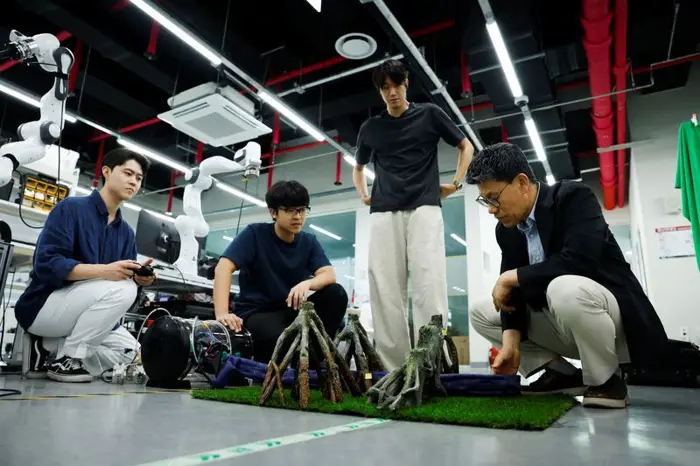
The technology is inspired by climbing ivy plants. Instead of moving an entire robotic structure at once, the flexible vines grow forward from their tips. This allows them to move smoothly around curved surfaces and closely follow the shape of the human body.
Professor Ryu Jee-Hwan of KAIST explained that this design allows the robotic vines to pass through narrow spaces while adapting to different body shapes. The system can also operate on surfaces with different textures, including slippery, rough, or sloped areas.
One of the major advantages of the new technology is its simple operation. The researchers said it does not rely on complex computer control systems to guide every movement. Instead, the flexible mechanical design naturally directs the clothing into position.
This approach may improve reliability while reducing the amount of computing power needed to operate the system.
The research team believes the technology has several practical applications beyond everyday clothing. One important use could be helping older adults or people with physical disabilities dress more independently.
Automatic dressing systems could reduce the need for assistance and improve daily comfort for individuals with limited mobility.
The researchers also see strong potential in industrial environments. Workers in semiconductor manufacturing often need to quickly put on specialized cleanroom suits while avoiding contamination. A self-dressing system could make that process faster and more consistent.
Emergency responders may also benefit from the technology. Firefighters, medical teams, and hazardous materials personnel frequently need to wear protective equipment within seconds. Automatic dressing could help reduce preparation time during emergency situations.
The project also highlights the growing role of mechanical engineering in robotics. While much public attention focuses on artificial intelligence software, the researchers said physical robotic design remains equally important for solving practical problems.
They believe combining innovative mechanical systems with advanced software will continue to expand the capabilities of future robotic technologies.
Although the system is still in the research stage, the successful demonstration shows how wearable robotics could become more useful in healthcare, manufacturing, emergency services, and everyday life.
As development continues, self-dressing robotic clothing may become a valuable tool for improving independence, workplace safety, and efficiency across many industries. The new technology represents another step toward making advanced robotics a practical part of daily human activity.
