


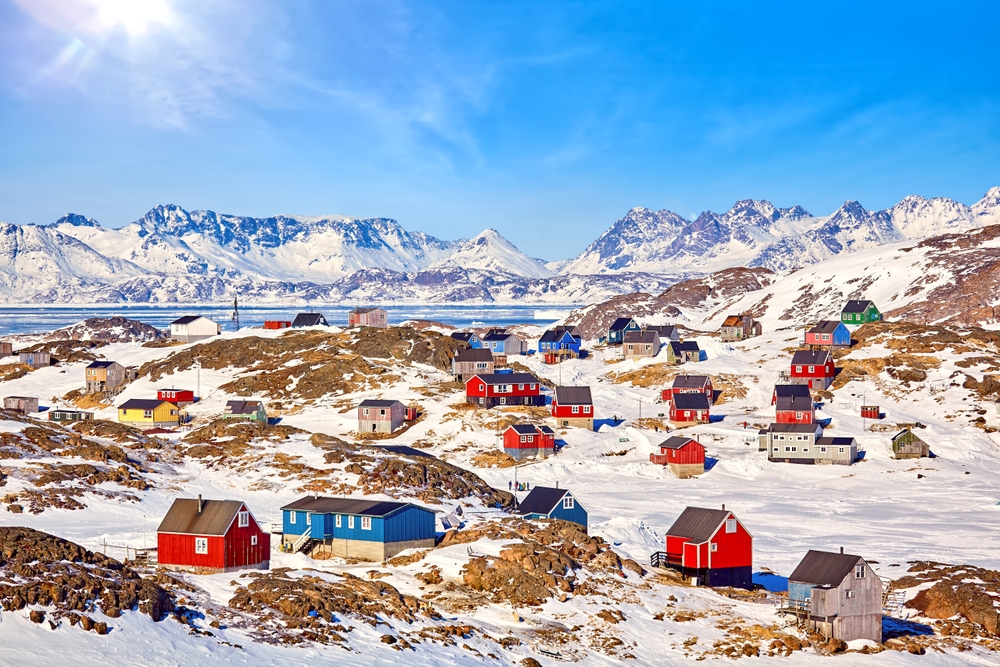
Greenland, the vast Arctic island off Canada’s northeastern coast, has become the focus of renewed geopolitical attention after the White House suggested that military action remains “an option” in President Donald Trump’s efforts to bring the territory under US control.
The island’s strategic location—more than two-thirds of it lies within the Arctic Circle—has made it a key component of North American defense since World War II. Its mineral wealth and position near critical Arctic shipping lanes only add to its significance.
White House Signals Hard-Line Approach
White House press secretary Karoline Leavitt said Tuesday that Trump considers acquiring Greenland a national security priority. “It’s vital to deter our adversaries in the Arctic region,” she said, adding that the president and his team are evaluating multiple options, with the use of the US military remaining at the commander-in-chief’s disposal.
Trump first proposed buying Greenland during his first term, but the idea resurfaced after the weekend’s US operation in Venezuela, which saw President Nicolás Maduro seized. The president cited the presence of Chinese and Russian activity in the Arctic as justification for the US to take control.
Despite the White House’s statement, other officials, including Trump’s Greenland special envoy Jeff Landry and deputy chief of staff Stephen Miller, indicated that military intervention was unlikely. Republican House Speaker Mike Johnson also rejected the notion of using force.
Allies Push Back, Reaffirm Greenland’s Sovereignty
The renewed US interest prompted international pushback. Leaders from France, Germany, Italy, Poland, Spain, and the UK joined Danish Prime Minister Mette Frederiksen in asserting that Greenland “belongs to its people.” The statement emphasized that Greenlanders, together with Denmark, have sole authority over their affairs.
Canada also voiced support for Denmark, with Prime Minister Mark Carney announcing a visit to Greenland next month by Canada’s Governor General Mary Simon and Foreign Minister Anita Anand. “The future of Greenland and Denmark are decided solely by the people of Denmark,” Carney said.
Trump’s envoy Landry, however, said he preferred to speak directly with Greenland residents rather than Danish officials or European diplomats, citing a desire to discuss opportunities to improve quality of life on the island.
Why Greenland Matters
Greenland is more than a strategic military outpost. The US operates the Pituffik Space Base in northwestern Greenland, established under a 1951 defense agreement with Denmark. The base is critical for missile warning, missile defense, and space surveillance for the US and NATO.
The island also guards part of the GIUK Gap, a key maritime corridor monitored by NATO to track Russian naval activity in the North Atlantic. Economically, Greenland is rich in rare earth minerals, essential for electronics and renewable energy technologies, and potential offshore deposits of oil and natural gas have been identified.
Greenland has had self-governing status since 2009, including the right to pursue independence under international law—a path supported by the majority of its residents. For now, the island’s future remains firmly in the hands of Greenlanders and Denmark, even as global powers continue to eye its strategic and economic potential.
